Transporting Remains Out of Ontario: Provinces, Airlines, Ashes vs a Casket
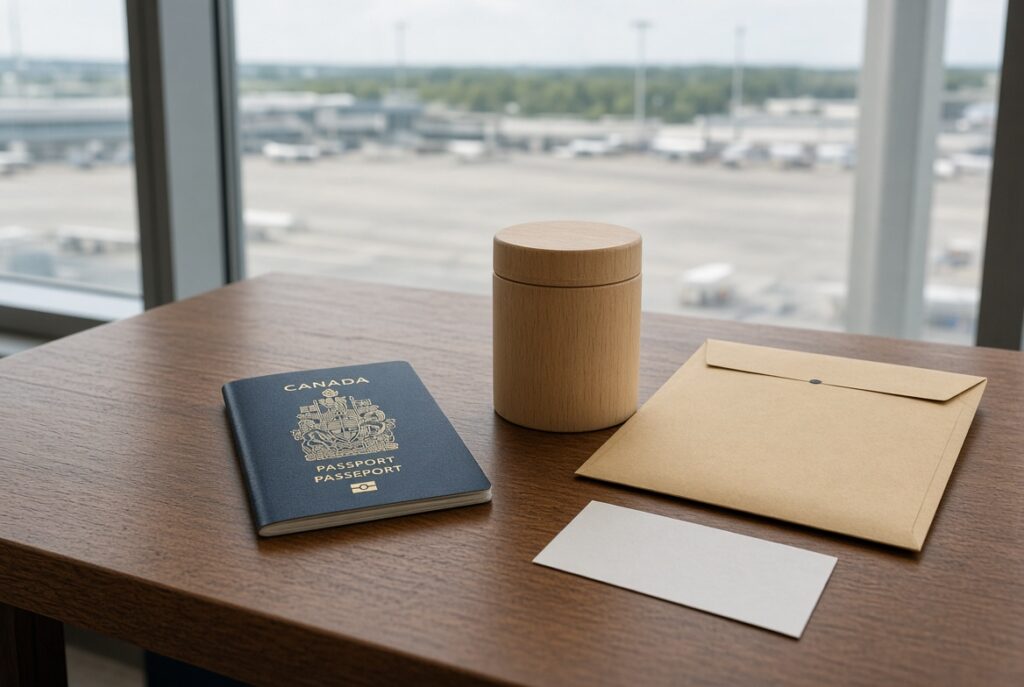
transporting remains
Taking someone home is often the whole point of the funeral. “Home” may be Winnipeg, Guangzhou, or a village in Punjab. Ontario will let the remains leave. It will not let them leave on a family member’s say-so.
Two different jobs sit under the same heading:
- moving a body (casket or air tray)
- moving cremated remains (or hydrolysis remains) in an urn
The first needs a coroner and usually a licensed funeral home. The second is lighter, cheaper, and still easy to get wrong at CATSA.
Leaving Ontario with a body
The Coroners Act is blunt. No one may ship or take a dead body from a place in Ontario to a place outside Ontario unless a coroner has certified that there is no reason for further examination. That paper is the Certificate for Shipment of a Body Outside of Ontario (form 0126).
Licensed funeral homes, transfer services, and crematoriums apply for it online through the Office of the Chief Coroner. Families rarely file this themselves.
Two other Ontario rules sit beside that certificate:
- The death must still be registered and a burial permit issued under the Vital Statistics Act. The coroner’s form does not replace that.
- No one who knows the body will leave Ontario may embalm or apply chemicals until the shipment certificate is issued.
The receiving province or country then adds its own list: transit permit, sealed casket, embalming certificate, letter that the death was not from a listed communicable disease. Ask the receiving funeral home before you pick a flight. Manitoba does not use Ontario’s forms. Italy will not care that your Toronto director “always does it this way.”
Who may move the body inside Ontario is a separate BAO question. A family member may transport from the place of death if they charge nothing. Crossing the provincial line with an unprepared body is not a DIY weekend drive. Use a licensed operator.
What a casket shipment actually looks like
Airlines treat a full-body transfer as cargo, not as a passenger with extra luggage. A licensed funeral home or known shipper books it. You generally cannot sit in 14C while the casket rides below you on the same ticket.
Typical preparation:
- shipment certificate + burial permit + medical certificate of death
- embalming if the destination or the airline requires it
- leak-proof inner container; many international routes want a hermetically sealed zinc or equivalent liner
- outer air tray so cargo handlers can move it
- IATA-style labelling for human remains
Domestic air cargo inside Canada often starts in the low thousands of dollars for the flight alone. International repatriation commonly lands $8,000 – $15,000+ once preparation, documents, and two funeral homes are included. Road transport to Montreal or Detroit can be cheaper if the receiving home will meet the vehicle.
Infectious disease, an open coroner’s file, or a weekend death will add days. Do not book non-refundable family tickets until the receiving side confirms the arrival window.
Leaving Ontario with ashes
Cremated remains are not a “body” under section 13 of the Coroners Act. You still need the usual Ontario cremation path: death registration, burial permit, and the coroner’s cremation certificate ($75) before the cremation happens. After that, taking the urn to another province is mostly a logistics problem, not a second coroner certificate.
By car inside Canada. Keep the cremation certificate and a proof-of-death letter in the glove box. There is no interprovincial “ash permit.”
By air from a Canadian airport. CATSA will screen the container. Officers may not open it. If they cannot clear it by X-ray, it does not get on the plane. A dense metal urn is the usual failure.
Do this:
- Use a temporary wood, plastic, or cardboard container for the flight. Transfer to the display urn after you land.
- Carry the urn in the cabin if the airline allows it. Many carriers discourage or refuse ashes in checked bags.
- Bring the death certificate and cremation certificate. They do not replace screening, but they stop a long argument at the gate.
- Confirm the airline 48 hours ahead. Air Canada, WestJet, Porter, and Air Transat all have their own notes.
- CATSA suggests cargo or another method for remains over about 350 ml if screening looks doubtful.
Declare the urn if a customs officer asks. Do not pack it inside a toiletry bag and hope.
Sending ashes out of Canada
Canada does not require an export licence for cremated remains. The destination country does the heavy lifting.
Pack a core set every time:
- certified death certificate (ServiceOntario long form if they want details)
- cremation certificate from the crematorium
- letter from the funeral home identifying the contents
- your passport and the deceased’s cancelled passport, if the embassy asks for it
Then add what that country wants:
| Destination (typical) | Extra step families hit |
|---|---|
| United States, United Kingdom | Often just the core set |
| Many EU countries, Mexico | Apostille on Canadian documents (Canada joined the Apostille Convention in 2024) |
| India | Apostille plus a consular no-objection process |
| Other countries | Embassy “covering letter,” non-contagious letter, or a local transit permit |
Start the embassy file the week of the cremation. Global Affairs authentication queues run long. A family already on a flight with a metal urn and no apostille is the story funeral directors tell each other.
Canada Post and major couriers accept properly packed ashes on some lanes. Air cargo through a funeral home is slower to book and safer when the receiving cemetery will not accept a parcel from a cousin.
Coming the other way (into Ontario)
If the death was outside Canada, Global Affairs and the Canadian mission abroad help with local funeral homes and paperwork. CBSA wants a death certificate (translated if it is not in English or French) and a leak-proof container. A cremation certificate helps. A full-body import follows quarantine rules if the cause of death is missing or infectious.
Once the remains are in Ontario, local registration and cemetery or crematorium rules apply as if the death had happened here — plus whatever the sending country already stamped.
A working order of calls
- Confirm who has authority to arrange the funeral in Ontario.
- Tell the licensed funeral home the destination city and whether you want a body or ashes to travel.
- If it is a body: coroner’s shipment certificate, then burial permit, then the receiving home’s list.
- If it is ashes: cremate in Ontario, then match the urn to CATSA and the airline.
- Call the destination embassy or the receiving funeral home before you pay for flights.
- Keep originals in a sleeve taped to the outside of the shipping container, copies in your bag.
Moving someone across a border is paperwork with a heartbeat behind it. Give the licensed provider the destination on day one. The cheapest mistake is a sealed bronze urn that cannot pass the X-ray at Pearson.