Where to Place Cremated Remains in Ontario: Home, Niche, Grave, or Garden
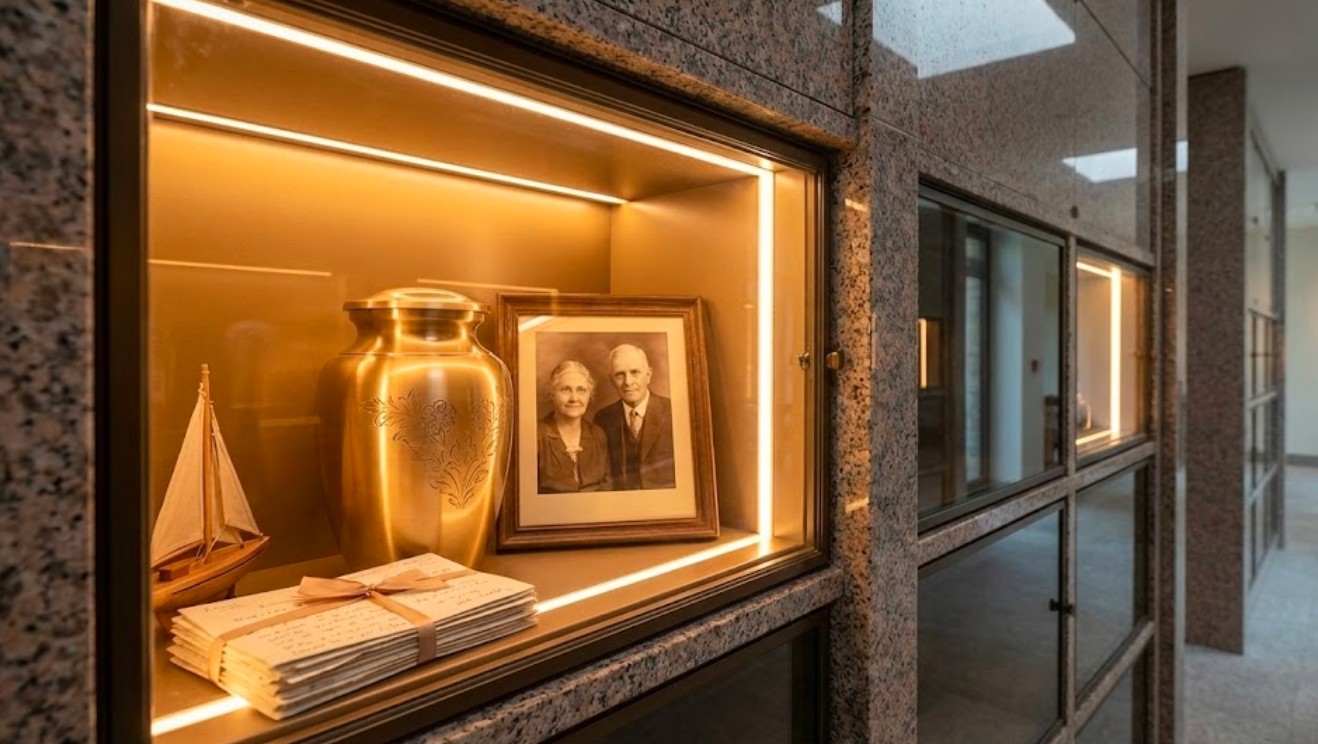
Niches in Funeral Homes
Cremation answers “how.” It does not answer “where.” Families leave the funeral home with an urn and a quiet question: do we keep this on the mantel, bury it, place it in a wall of niches, or scatter it?
There is no single right answer. Ontario law allows several. What changes is whether later generations have an address they can find on a map.
This guide covers the common choices, what they cost in rough 2026 terms, and the rules that catch people out.
You can keep the urn at home
Ontario does not require you to take cremated remains (or remains from alkaline hydrolysis) to a cemetery. Many families keep the urn for months or years while they decide. Some never move it.
If you keep it at home:
- Tell the executor and at least one other person where it is.
- Choose an urn that will not spill if someone knocks it.
- Write down what you want done later. Houses sell. Adult children move. An urn in a closet is easy to lose in a downsizing.
You may also divide the remains among small keepsake urns so more than one household has a share. The cemetery will still want a record if you later bury or niche only part of them.
Columbarium niches: a named space above ground
A columbarium is a wall or building of small compartments (niches). Staff place the urn inside and seal or lock the front.
Outdoor granite niches take an engraved stone or bronze plaque. They sit in all weather.
Indoor glass-front niches (usually in a mausoleum) let you show the urn and a few small objects — a photo, a pin, a team cap. Check the cemetery’s bylaws. Many ban food, candles, and anything that can leak or attract pests.
Typical 2026 ranges outside premium downtown Toronto:
- Niche rights: about $1,500 – $8,000 (glass-front and indoor units cost more)
- Opening / inurnment fee: about $350 – $700
- Inscription or plaque: often $400 – $1,500 if it is not in the package
A niche often holds one or two urns. Measure your urn before you buy. A large wood box will not fit a 12-inch cube.
You visit year-round without standing in frozen mud. You also pay for a space that is not “yours” as real estate. You buy interment rights, plus a contribution to the cemetery’s care-and-maintenance fund.
Burying an urn in the ground
Three common versions:
- A cremation grave sized for urns only, with a flat marker or small upright stone.
- An existing family casket plot. Many Ontario cemeteries allow one or two extra urns on a grave that already holds a casket — sometimes more if the first burial went in at extra depth. The bylaw controls the number, not a guess from the funeral home.
- A new full-size lot used only for urns, if you want one monument for several people.
Each placement usually needs its own opening-and-closing fee (often $500 – $1,000 for cremated remains). The stone is extra.
This is how families keep grandparents and a later cremation in the same square of grass. Ask the cemetery, in writing, how many urns that specific lot still allows.
You cannot bury an urn in a backyard or cottage lot in Ontario unless that land is a licensed cemetery. Scattering on your own property is different (see below). Burying the container is not.
Cemetery scattering gardens
Some families want nature and still want a plaque.
A licensed cemetery scattering garden lets you scatter (or, at some sites, place a biodegradable container) in a defined bed or lawn. Staff record the scattering. You can usually buy a name on a communal wall or boulder.
Hamilton municipal cemeteries, for example, list a scattering fee of a few hundred dollars plus an inscription on a shared memorial. Other grounds bundle a plaque into the price. Once scattered in the garden, you generally cannot take the remains back.
Compare that with scattering on Crown land or a Toronto waterfront park: legal in many places, no cemetery fee, and no guaranteed marker. Trails change. Families forget the exact bay. That is a fair trade for some people and a loss for others.
Cenotaphs when the ashes are elsewhere
A cenotaph is a cemetery marker for someone whose remains are not in that ground — scattered in another province, buried overseas, or lost at sea. Genealogy-minded families use them so there is still a stone in the hometown cemetery.
You still buy memorial rights and follow size rules. You do not buy a grave for a body.
Scattering outside a cemetery (Ontario rules)
You may scatter cremated or hydrolysis remains:
- on private land with the owner’s consent (the owner cannot charge a fee unless they hold a cemetery licence)
- on unoccupied Crown land, including many provincial parks and Great Lakes waters, if nothing is posted against it
- on municipal land if local bylaws allow it (Toronto allows scattering in city parks and Lake Ontario without a city permit)
Scatter the powder. Do not sink the urn, flowers, or fruit. If the same private lot is used again and again for scatterings, the owner may have to license it as a cemetery.
Faith may limit the choice. Some traditions want the remains together in consecrated ground. Ask before you split or scatter.
How to choose without rushing
Ask, in this order:
- Do we need a place later generations can find?
- Do we already own a grave that can take urns?
- Do we want to visit in January?
- What will the urn actually fit?
- What does the cemetery bylaw allow on this lot or this niche?
Get the cemetery price list. Interment rights, opening fees, inscriptions, and HST are separate lines. In Ontario a licensed cemetery must give you that list.
A funeral ends in a day. An urn can wait. Home, niche, family grave, garden, or a river with no plaque are all lawful paths. Pick the one your people will still understand in twenty years — then write it down.