What Is Water Cremation? A Guide to Aquamation in Canada
Aquamation
For decades most Canadian families chose a casket burial or flame cremation. A third option now sits on some price lists: alkaline hydrolysis. You will also hear aquamation, water cremation, bio-cremation, or flameless cremation.
In Ontario the legal name is hydrolysis. The Bereavement Authority of Ontario (BAO) tells licensed operators they may use “aquamation” in marketing, but contracts and forms must say hydrolysis — not cremation.
If you want an urn and a memorial without fire, this is how the process works, what you get back, and where you can actually book it in 2026.
How aquamation works
Staff place the body in a stainless-steel vessel with a solution of about 95% water and 5% alkali (potassium hydroxide or sodium hydroxide — the same family of compounds used in soap making). Heat, water flow, and alkalinity speed up the breakdown of soft tissue.
Two machine types exist:
- Higher heat and pressure: roughly 150°C, often 6–8 hours
- Lower heat: closer to boiling, often longer
That is not a campfire in a tank. The vessel stays closed. There is no flame and no smokestack.
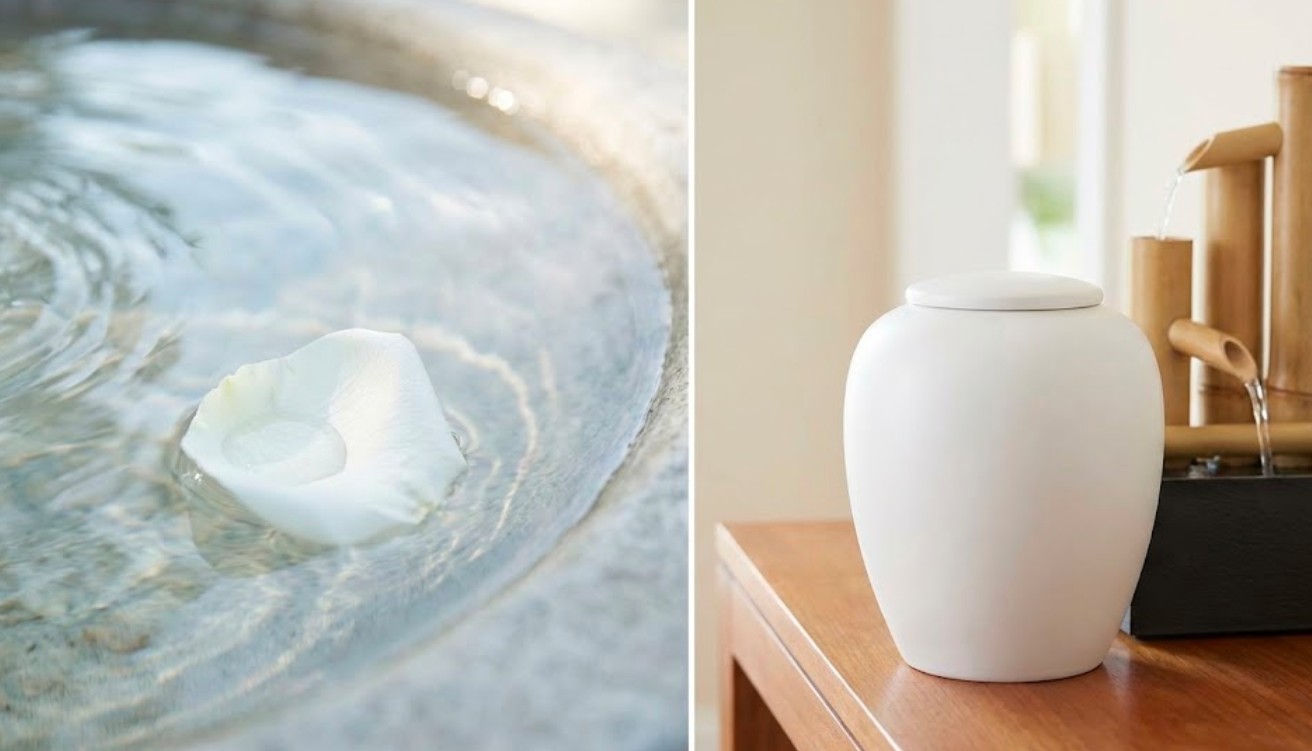
When the cycle ends, staff drain the sterile liquid (amino acids, salts, sugars, and soaps — the chemistry of natural decomposition, accelerated). They dry the remaining bone fragments and process them into a powder, then place that powder in an urn for the family.
Metal implants and dental amalgam stay intact. Providers can recycle them instead of sending mercury up a crematorium stack.
What families receive
You receive mineral remains, just as you do after flame cremation. Families often notice two differences:
- The powder is usually whiter and finer
- Volume is often about 20–30% greater, so you may want a slightly larger urn
Ontario treats these remains like cremated remains for scattering and burial. You may place them in a cemetery niche or grave, keep them at home, or scatter them on Crown land, many provincial parks and Great Lakes waters, municipal land if bylaws allow, and private land with the owner’s consent. Scatter the powder. Do not sink the urn.
The process liquid goes to the municipal wastewater system after treatment, the same pathway funeral homes already use for embalming discharge.
Why some Canadians choose it
Lower combustion emissions. Flame cremation burns natural gas at roughly 800°C or higher and can release mercury from fillings. Aquamation uses electricity and water. Published comparisons put direct carbon from aquamation far below a typical flame cremation — often cited as under 20 kg CO₂e versus well over 100 kg for fire, depending on the local electricity grid.
No smokestack. Neighbours and some families care about that.
A water process. Some people simply do not want fire.
Be honest about the rest. Aquamation uses more water and more electricity than a retort. If the nearest licensed unit sits hours away, transport adds cost and emissions. Green burial can have a smaller footprint still, if a natural-burial cemetery is nearby. Human composting (natural organic reduction) is not legal in Canada as of 2026.
Is it legal in Canada?
Funeral law is provincial. As of 2026, alkaline hydrolysis is permitted in:
- Saskatchewan (first mover, 2012)
- Ontario (2015; BAO-licensed hydrolysis facilities)
- Quebec (the funeral law covers disposition “by fire or by any other chemical or physical process”)
- Newfoundland and Labrador
- Northwest Territories
Some industry lists also include Manitoba. British Columbia and Alberta still do not treat it as an approved method of disposition. Confirm with a local licensed funeral home before you prepay.
Legal and available are not the same thing. Ontario has only a handful of licensed hydrolysis sites (eastern Ontario, Durham Region, and more recently southwestern Ontario). Many GTA families still ship the person to Peterborough, Whitby, Kingston, Arnprior, or Chatham. Quebec’s commercial option has been concentrated in Granby. Ask who holds the licence, where the vessel sits, and what the transfer fee is.
Cost
Expect aquamation to cost a little more than a basic direct flame cremation and much less than a full casket burial. Canadian quotes often fall in a roughly $2,000–$5,000 band for the process itself, before visitation, an urn, or cemetery rights. Specialized equipment and a longer cycle drive the premium.
In Ontario you need a disposition permit, the same as for burial or cremation. You can buy hydrolysis in advance under BAO prepaid-contract rules; the operator still cannot mislabel it as cremation on the contract.
Faith and culture matter. Some traditions require burial; others prefer fire. Ask your imam, priest, rabbi, granthi, or Elder before you assume water is an accepted substitute.
Questions to ask the funeral home
- Are you licensed for hydrolysis, or do you transfer to another operator?
- Where does the process actually happen?
- What is the itemized price, including transfer, container, urn, and permits?
- How long until we receive the remains?
- Can we have a visitation first?
- How do you handle implants and dental amalgam?
Get the answers in a written contract.
Bottom line
Aquamation is a licensed, water-and-alkali process that returns bone mineral in an urn. Ontario has allowed it for a decade. Supply is still thin, so plan for travel. If you want lower stack emissions or you reject flame, it is a real third choice beside burial and fire — not a replacement for every family, and not yet a coast-to-coast option.
Check current listings with a BAO-licensed funeral home in Ontario, or with the provincial regulator where you live.